May 30, 2026
Aari Work: The Hooked-Needle Embroidery of Kashmir and Gujarat
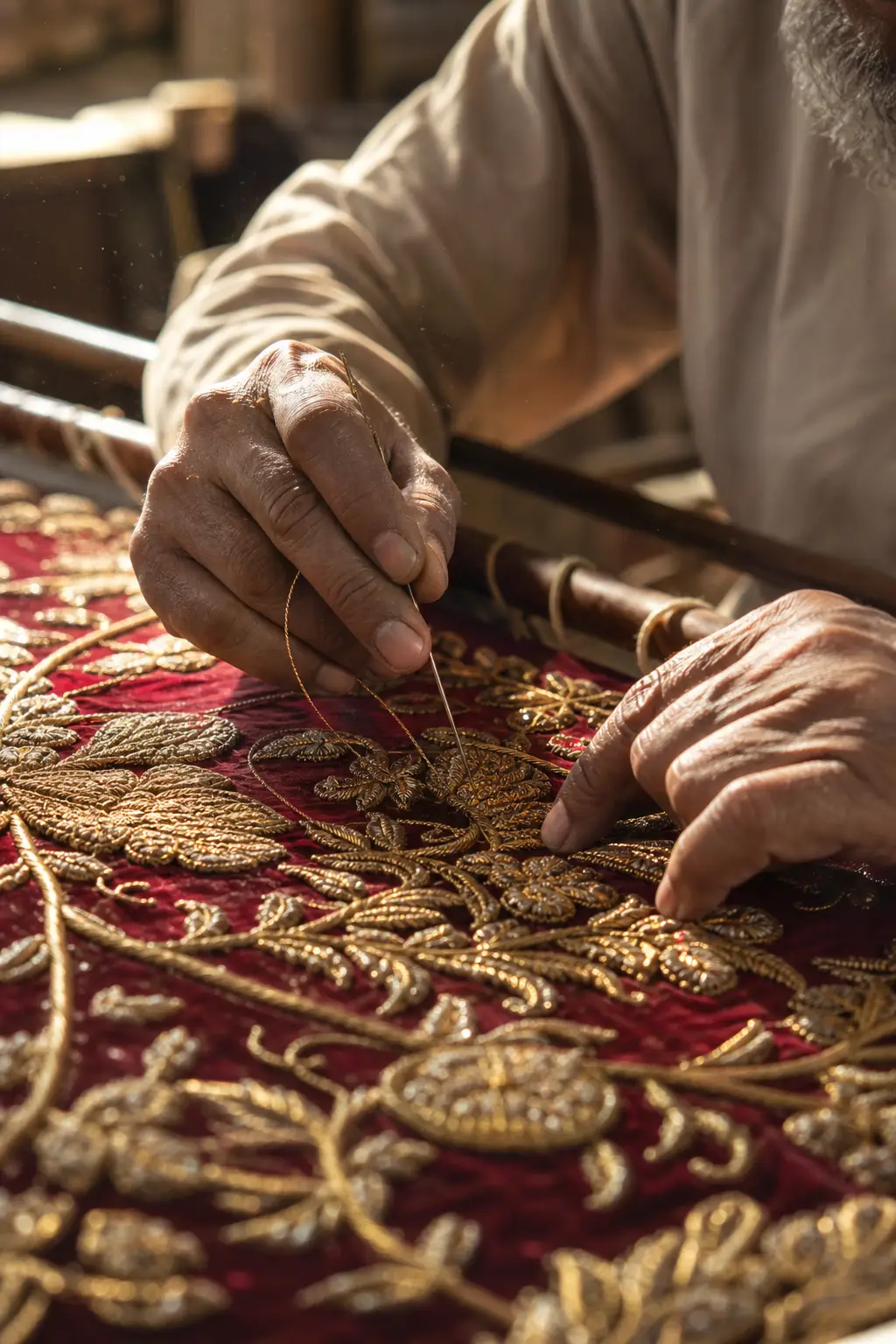
What is Aari Work?
Aari (also called *ari*, *aari kaam*, or in Gujarat *mochi bharat*) is hooked-needle chain-stitch embroidery done on a stretched fabric frame. The karigar uses a tiny crochet-like hook (the *aari* needle) to draw a continuous thread from below the fabric to above, creating a chain stitch much faster and more precisely than a regular needle can.
Aari is what makes the flowing, continuous floral lines you see on most modern Indian bridal pieces — the technique allows a karigar to embroider in long, unbroken curves at roughly 3–4 times the speed of a standard satin stitch, without sacrificing fineness.
It is, in many ways, the workhorse stitch of Indian couture. Most "hand-embroidered" lehengas you see in Delhi are predominantly aari work, often combined with zardozi and beadwork for highlights.
Three Distinct Regional Traditions
Aari is practised across India, but three regions own it culturally:
Kashmir (Srinagar, Anantnag):
The Kashmiri aari tradition uses fine wool or silk thread on woollen *raffal* fabric to create the famous *crewel embroidery* of Kashmir — floral *chinar* leaves, *paisley*, and *gulab* roses. This is the aari you see on Kashmiri shawls, jackets and home textiles. Patronised by Mughal emperors from the 16th century.
Gujarat (Kutch, Saurashtra — "Mochi Bharat"):
Practised by the Mochi community (traditionally leather-workers), Kutchi aari is bold, colourful, and figurative — peacocks, parrots, dancers, elephants, and mirror-work inserts. The Kutchi *mochi bharat* technique was historically used on bridal *ghaghra*, royal canopies, and temple textiles. The 19th-century Maharaos of Kutch patronised entire workshops.
West Bengal (Murshidabad):
A finer, more painterly tradition using silk thread on muslin and silk — often used for embroidered *Baluchari* sarees and *nakshi kantha*-adjacent work.
In the modern Delhi couture industry, however, "aari" most often refers to a hybrid commercial style done in workshops across Delhi, Mumbai, Bareilly, and Lucknow — using the aari hook but with mixed thread, sequin, bead and stone work in a fashion-led vocabulary.
How an Aari Karigar Works
The fabric is stretched on the same adda frame used for zardozi. The karigar sits cross-legged at the frame and works from above, holding the thread spool below. The aari hook punches down through the fabric, catches the thread, and pulls a small loop back up. The next punch goes through that loop and pulls a new one — a chain stitch, formed entirely from the top side.
This is significantly faster than a regular needle (which has to be passed up and down through the cloth twice per stitch), and it creates a more even, mechanical-looking line — which is why aari is sometimes mistaken for machine embroidery.
A key tell: real aari shows a tiny chain on the top face and a flat running stitch on the back face. Machine chain-stitch shows the chain on both faces.
Materials Used With Aari
Aari hooks can carry almost anything:
A typical Delhi bridal lehenga in 2026 will combine aari outline + aari fill + zardozi accent + suchak stone insets, with aari forming roughly 70% of the embroidery surface.
What Aari Adds to a Bridal Lehenga
How to Spot Quality Aari
Closing
Aari is the unsung backbone of Indian bridal couture — most of what you call "hand embroidery" is, technically, hand aari. At Le Wraps we work with karigars trained in the Lucknow-Delhi aari tradition, often combined with Kashmiri crewel for jackets and dupattas.
If you want a craft that looks intricate, photographs beautifully, and won't add 1.4 kg to your lehenga — ask for aari-led work.
Commission an aari-led bridal lehenga
Lighter, flowing, faster — book a private consultation with Nidhi Sachdev at Friends Colony East.
Book your consultationReady to Experience Bespoke?
Connect with our fashion stylist at Le Wraps — Delhi's finest luxury boutique.
Connect with Our Stylist